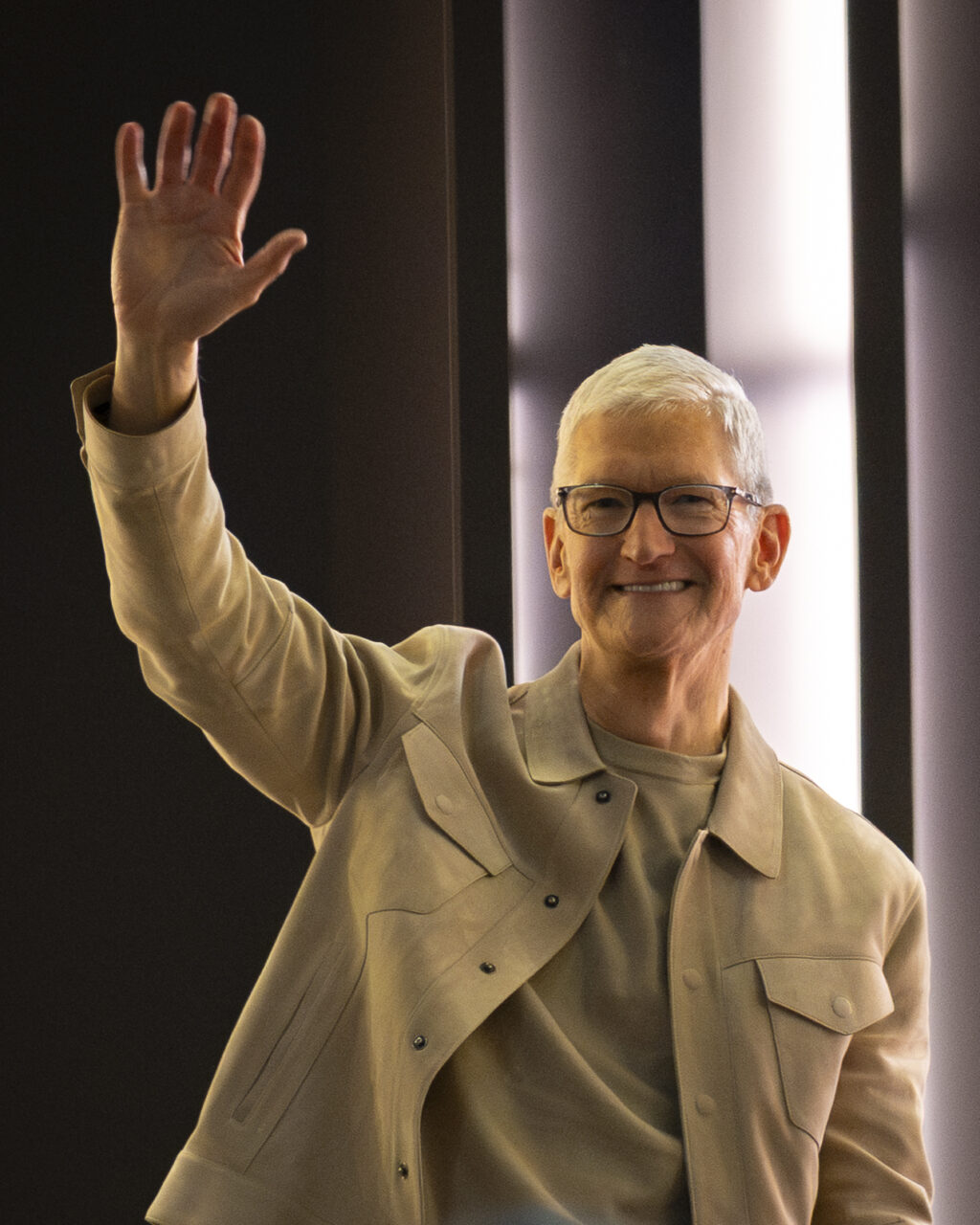
On Monday, June 8, Tim Cook walks onto the WWDC stage at Apple Park for what everyone already knows is his last keynote as CEO. After 15 years, four US presidents, three pandemic-disrupted product cycles, and a stock chart that turned Apple into the most valuable company in human history, Cook hands the keys to John Ternus on September 1.
This is the most carefully planned CEO transition in Apple’s history. It’s also the most consequential, because Cook is exiting at the precise moment Apple is widely seen as behind on the most important technology shift of the decade. The man who took over from Steve Jobs in 2011 will be remembered for scaling Apple to a size no one thought possible. The man taking over from him in September has to figure out whether Apple can still invent.
The Numbers: What Tim Cook Built at Apple
Start with the basics, because the basics are extraordinary.
When Cook took the CEO chair on August 24, 2011, Apple was valued at roughly $350 billion. Today Apple sits north of $4 trillion. That is more than a tenfold increase, in 15 years, on a base that was already enormous. Apple’s market cap is now roughly the size of Britain’s entire economy.
Revenue in the fiscal year ending September 2011 was around $108 billion. The fiscal year ending September 2025 closed at $416 billion. Net income hit $112 billion, eight times what Apple posted the year before Cook took over. The services business alone, which barely existed in 2011, generated $109 billion in FY2025, more than the entire company made in the year Cook started.
Apple was the first US company to hit a $1 trillion market cap in 2018, the first to hit $2 trillion in 2020, and the first to hit $3 trillion in 2023. Each milestone happened on Cook’s watch.
This is the legacy nobody can argue with.
From Steve Jobs to Tim Cook: The Inheritance Problem
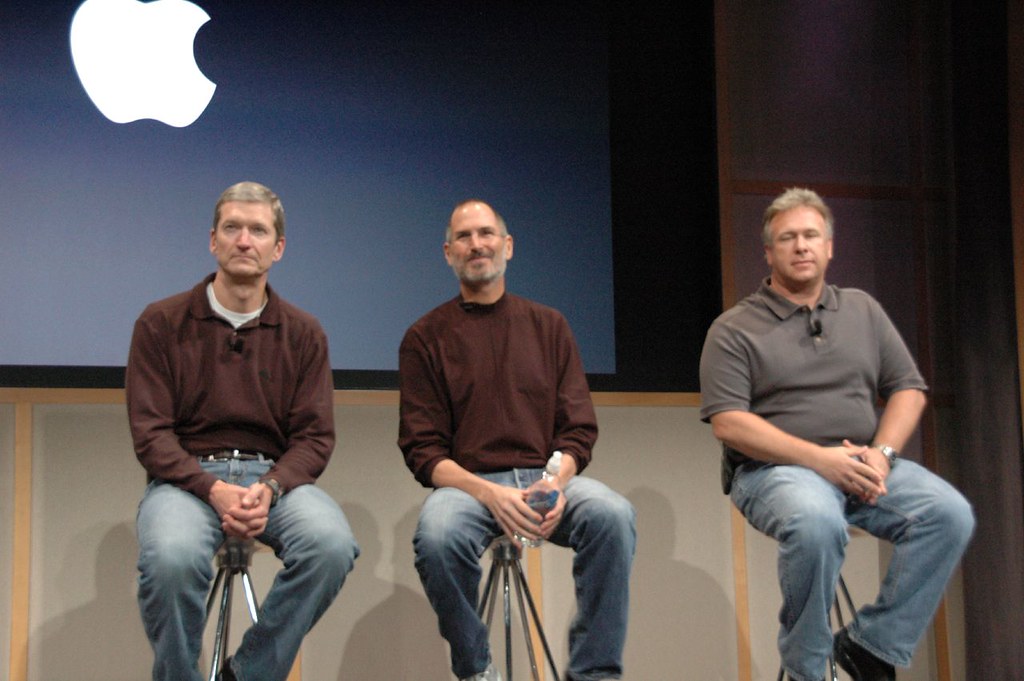
When Cook took over in 2011, the consensus was that he was Apple’s worst-case scenario. A logistics guy following a visionary founder. The bar for him was not “build the next iPhone.” The bar was “don’t destroy what Jobs left.”
He cleared that bar in his first 18 months and never looked back. The reason is that Cook understood what Apple actually needed at that point in its life cycle. Jobs had built a product company with a cult brand. Apple needed to scale that product company into a global financial machine without losing the brand. Cook is arguably the best supply chain operator the tech industry has ever produced, and he turned that operational discipline into a moat that no competitor has been able to cross.
Critics like to say Cook isn’t a product person. That’s largely true, and it’s also beside the point. Jobs himself reportedly described Cook as “not a product person, per se.” Cook’s mandate from the board was never to invent the next product category. It was to scale the existing ones into a trillion-dollar service economy. He did exactly that.
Cook’s Biggest Wins at Apple
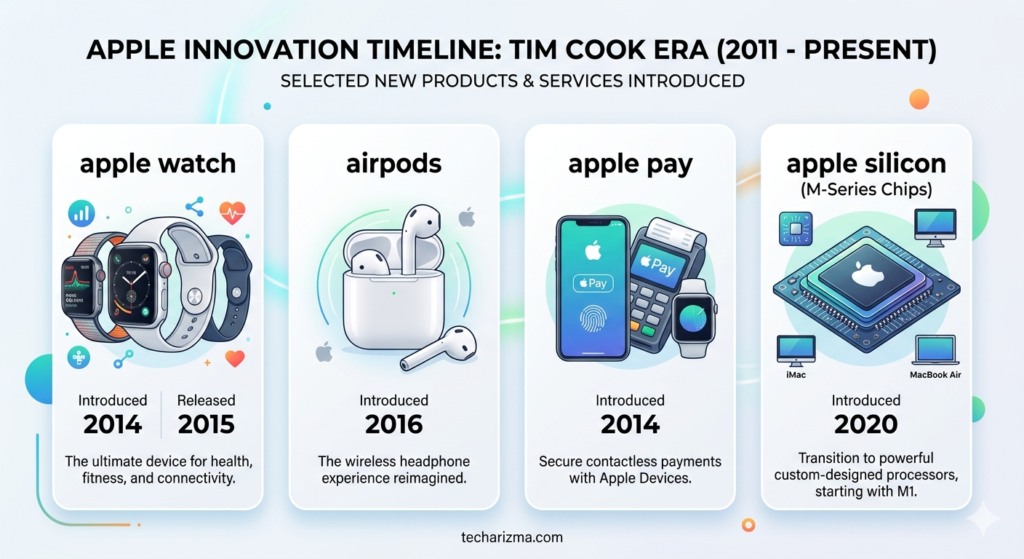
A scoreboard of the products and decisions that defined the Cook era:
Apple Watch (2015). The first major new product category launched entirely under Cook. Now a $20 billion-plus annual business and the default smartwatch by a wide margin.
AirPods (2016). Launched to widespread ridicule, ended as one of the most influential consumer products of the decade. The category-defining device for wireless audio.
Apple Pay (2014). Used by around 818 million people globally. Quietly one of the most successful financial products ever launched by a tech company.
The services pivot. Apple Music (2015) now has over 112 million subscribers. Apple TV+ (2019) won the Best Picture Oscar for CODA in 2022. iCloud became a real business. The App Store generated tens of billions in commission revenue. Combined, services hit $109 billion in FY2025.
Apple Silicon (2020 to 2023). The most technically impressive move of Cook’s tenure. Apple transitioned the entire Mac lineup from Intel to its own custom chips. Battery life improved dramatically, performance leapfrogged the industry, and Apple bought itself silicon independence that now underpins everything from the MacBook Pro to the Vision Pro to the AI features Apple is racing to ship.
The iPhone scale-up. Cook didn’t invent the iPhone. He turned it into the most profitable consumer product in human history. Face ID, edge-to-edge displays, the iPhone SE for the low end, ProMotion, computational photography, all shipped under his watch.
Cook’s Misses
The scoreboard isn’t all wins, and the Ternus era inherits the misses.
The Apple Car. Project Titan ran for roughly a decade and consumed an estimated $10 billion before Apple finally killed it in 2024. Internally, employees reportedly called it “The Titanic Disaster.” It’s the single biggest capital write-off in Apple’s history, and it happened in plain sight.
Vision Pro. Apple shipped the $3,499 mixed reality headset in 2024 to enormous fanfare. The product flopped commercially. Sales dropped roughly 95% from the first year to the second, Apple slashed production, and by 2026 the company has effectively deprioritized it. The Jobs-era promise that Apple only ships finished products quietly died with the Vision Pro.
The AI gap. This is the big one. Apple’s cloud-based AI model is reportedly behind OpenAI’s GPT-4o, which is itself over a year old. Apple’s on-device model runs at roughly 150 billion parameters. The custom Gemini model Apple licensed from Google in January 2026, reportedly worth around $1 billion per year, runs at 1.2 trillion parameters, roughly eight times larger than what Apple built in-house. The Siri overhaul Apple advertised heavily alongside the iPhone 16 in 2024 has been delayed three times and triggered a $250 million class-action settlement for false advertising.
iPhone design stagnation. The basic iPhone industrial design hasn’t fundamentally changed since 2019, when Jony Ive left as chief design officer. Apple has not filled the role since. Compare an iPhone 12 to an iPhone 17 and the family resemblance is so strong it’s hard to tell them apart at a glance.
The DOJ antitrust case. The US Department of Justice’s antitrust lawsuit, which alleges Apple has built an illegally restrictive ecosystem, is ongoing and will outlast Cook’s CEO tenure.
This is the Apple Ternus inherits. Profitable beyond imagination, structurally dominant, and visibly behind on the next platform shift.
Who Is John Ternus, Apple’s Next CEO?
Ternus is 51, a mechanical engineer by training, and a former competitive swimmer. He joined Apple’s product design team in 2001 and has spent 25 years inside the company. He became VP of Hardware Engineering in 2013 and Senior VP in 2021. When he steps into the corner office on September 1, he will be Apple’s eighth CEO in company history.
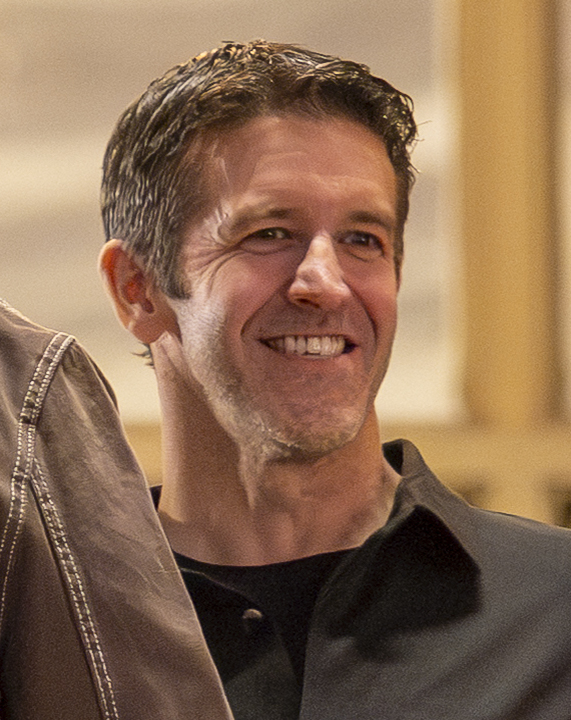
His fingerprints are on virtually every Apple product currently sold. Every generation of iPad. The recent iPhone lineup. AirPods. The Mac’s transition to Apple Silicon. Vision Pro hardware. He’s been on the WWDC stage for years, calmly walking through hardware reveals with the kind of low-key technical authority that Cook himself doesn’t have.
He is not Cook. He’s not a logistics CEO. He’s not a marketing CEO. He’s a hardware engineer who has been quietly running the most important part of Apple for over a decade. The closest historical analogy is the moment Steve Jobs returned in 1997 and started picking what to build based on what he believed in. Apple is making an explicit bet that the next era of competition will be won on hardware-software integration, not on operations or services. That’s a Ternus bet.
He’s also notably similar in age to Cook when Cook took over. Cook was 50. Ternus is 51. The board has likely just bought Apple another 10 to 15 years of leadership continuity, which matters when your competitors include companies that churn through CEOs every three.
What’s Next for Apple Under John Ternus
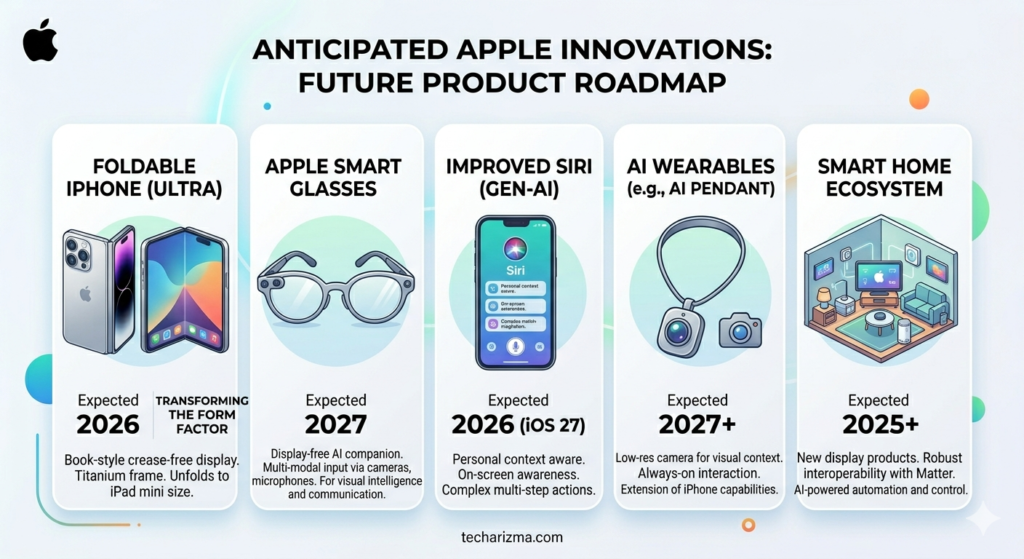
The product pipeline waiting for him is the most ambitious Apple has lined up in years:
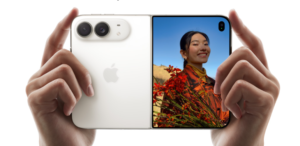
The foldable iPhone (September 2026). Expected alongside the iPhone 18 Pro. Book-style design with an internal display roughly the size of an iPad mini. Reported price tag as high as $2,400, which would make it the most expensive iPhone ever. Apple is roughly six years late to foldables, but it’s betting that it can do what Samsung has been refining since 2019, better.
AI smart glasses (late 2026 to early 2027). At least four frame designs are reportedly in testing, with launch-year shipments projected at three to five million units. These will not be standalone devices. They run through a connected iPhone, which means the entire glasses category depends on the Siri overhaul finally working.
AI wearables. A wearable pendant with a camera and AirPods with built-in cameras are both reportedly in development. The strategy is hardware-AI integration that Google and Microsoft can’t fully replicate, because they don’t own the device.
Home robotics. Reportedly in development for a 2027 launch or later.
The Siri rebuild. WWDC 2026 is when Apple has to prove it can finally deliver on the AI promises it made in 2024. The Gemini partnership is the foundation. Whether the demo lives up to the marketing this time is the single biggest test of Ternus’s first year, even though he isn’t technically CEO yet.
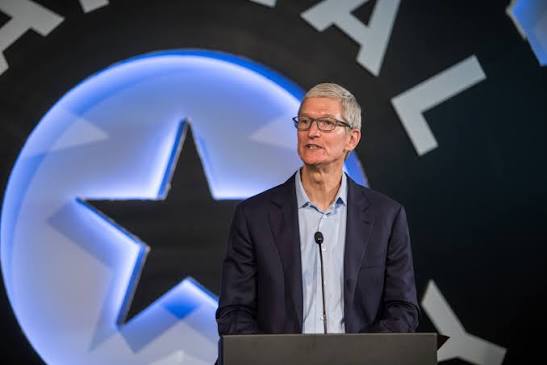
WWDC 2026: The Final Tim Cook Keynote
Monday’s keynote begins at 10am PT. Cook will be the headliner. Ternus will almost certainly have more stage time than usual, which is exactly what Apple’s PR machine has been engineering for the last two years.
The product story will be dominated by Siri’s relaunch and the Gemini-powered Apple Intelligence features that should have shipped 18 months ago. iOS 27, macOS 27, watchOS 27, and the rest will get their standard updates. The hardware groundwork for the foldable iPhone and the smart glasses will likely be laid in the developer APIs, even if the devices themselves stay off the stage.
But the subtext is what makes this keynote different. After 15 years of “Good morning” greetings and “one more thing” reveals he never quite owned the way Jobs did, Tim Cook is closing his run as Apple’s CEO. He built the most valuable company in the world. He also handed his successor an AI deficit that could define the next decade. Both things are true at the same time.
If Ternus pulls off the rescue, Cook’s legacy is secure. If he doesn’t, history may remember the Cook era as the period when Apple stopped inventing.
Either way, the man on stage Monday will be the most consequential CEO in tech for the last 15 years, taking his final bow at the keynote that shaped the industry he built.