Apple is seven years late to the foldable party. Samsung showed up with the first Galaxy Fold in 2019, and Apple strolled in on September 9, 2026 with the iPhone Duo. And honestly? Apple knows it.
There was no pretending they invented the category this time. The pitch was simple: we waited, we watched everyone else make the mistakes, and now we’re here. That’s the confidence of a company that knows its fanbase will line up regardless. Apple doesn’t need to be first. It just needs to be Apple.
I’m also late, by the way. The launch hype has come and gone, every tech channel has posted its first impressions, and here I am, a few weeks later. But I finally got my hands on the iPhone Duo at a store nearby, and I think a slower take is worth more than a rushed one. So here’s mine.
First touch: it feels like an iPhone, just wider
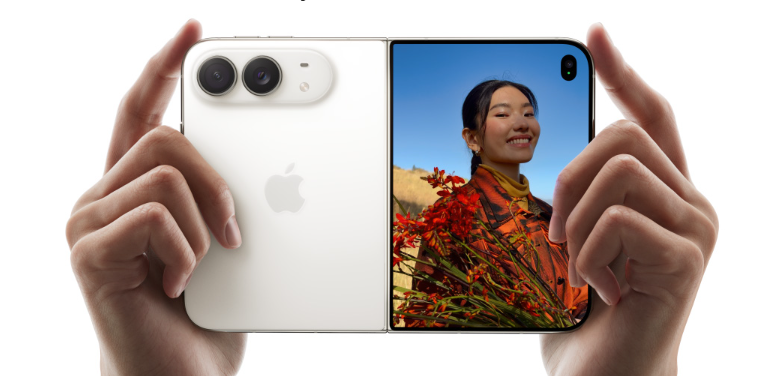
The first thing you notice is the shape. Closed, the Duo is short and wide, closer to a passport than a candy bar. The 5.4-inch cover screen felt usable for quick replies, not the cramped strip some early foldables gave us.
Open it, and the 7.6-inch inner display takes over. The Grade 5 titanium frame feels solid, and at 254 grams you know you’re holding something premium. It’s not light. It’s not a brick either.
Then I went looking for the crease. It’s there. Apple never claimed it was gone, only that the matte nano-texture finish makes it harder to see. Under the store lights, at an angle, I could spot it. Head-on, watching a video, I mostly forgot about it. That’s a better result than most foldables I’ve tried.
The hinge holds its position at different angles, so you can prop it half-open on a table. iOS 27 also moves controls to the side when the phone is partially folded, away from the crease. Small touch. Very Apple.
One more thing that made me smile: Touch ID is back, sitting in the side button. Face ID didn’t make it here.
Price and specs: $1,999 to start, and Apple isn’t apologizing
The Duo starts at $1,999 for 256GB. That’s $800 more than an iPhone 18 Pro, and it’s the most expensive iPhone Apple has ever sold. Max it out at 2TB and you’re at $3,199.
| Storage | US price |
| 256GB | $1,999 |
| 512GB | $2,199 |
| 1TB | $2,599 |
| 2TB | $3,199 |
Here’s what that money gets you:
| Spec | iPhone Duo |
| Inner display | 7.6-inch Super Retina XDR, nano-texture, ProMotion |
| Cover display | 5.4-inch Super Retina XDR, ProMotion |
| Chip | A20 Pro (6-core CPU, 7-core GPU) |
| Rear cameras | 48MP Fusion Main + 48MP Ultra Wide, 2x optical-quality zoom |
| Front cameras | 12MP Center Stage + under-display FaceTime camera |
| Thickness | 5.2mm open, 11.3mm closed |
| Weight | 254g |
| Battery (video playback) | Up to 44 hrs on cover screen, 31 hrs on inner screen |
| Unlock | Touch ID in side button (no Face ID) |
| Build | Grade 5 titanium, Ceramic Shield 2 front, IP68 |
| SIM | eSIM only, worldwide |
A few things jump out. No telephoto lens. No Face ID. No Action button. Apple traded all three for that 5.2mm unfolded profile, which is thinner than the iPhone Air. Bold choice at this price.
The eSIM-only point matters here in Pakistan too. If you’re planning to import one, check that your carrier supports eSIM first. Pre-orders open October 16, and the phone ships October 23.
Sources: Apple Store, iPhoneSoft, MacRumors
The rivals: Samsung, Huawei and Xiaomi got here first
Apple is walking into a room where Samsung is on its eighth Fold and Huawei owns the Chinese market. Here’s how the Duo stacks up on paper.
| Phone | Starting price | Screens (inner / cover) | Folded thickness | Weight | Chip | Rating |
| Apple iPhone Duo | $1,999 | 7.6″ / 5.4″ | 11.3mm | 254g | A20 Pro | IP68 |
| Samsung Galaxy Z Fold 8 | $1,899 | 7.6″ / 5.5″ | 9.7mm | 201g | Snapdragon 8 Elite Gen 5 | IP48 |
| Huawei Mate X7 | €2,099 (global) | 8.0″ / 6.49″ | 9.5mm | 235g | Kirin 9030 | IP58 / IP59 |
Samsung Galaxy Z Fold 8. Only $100 cheaper in the US, and that’s the real fight. The Fold 8 is lighter by more than 50 grams and slimmer when closed. It also has years of multitasking polish: three apps at once, floating windows, DeX. Where Apple wins is dust protection. The Duo’s IP68 beats the Fold 8’s IP48, which only keeps out particles bigger than 1mm.
Huawei Mate X7. The thinnest of the lot at 4.5mm unfolded, with a bigger 8-inch inner screen and a proper 3.5x telephoto. Huawei held nearly 70% of China’s foldable market through the first three quarters of 2025. The catch for buyers here in Pakistan is the same as always: no Google services out of the box.
Xiaomi Mix Fold 5. This is the one that hasn’t shown up yet. Leaks point to Xiaomi’s own Xring O3 chip, a 200MP main camera, a 6,000mAh battery and a price around CNY 10,000 (roughly $1,400). It’s expected to launch in China first. If those numbers hold, it undercuts the Duo by about $600.
So the Duo is not the cheapest, lightest or thinnest foldable. It doesn’t need to be. Its pitch is iOS, iMessage, AirDrop and the rest of the ecosystem, now on a bigger screen. For an iPhone user, none of the rivals can offer that.
Will it last? The first-gen question
This is the part I can’t answer from a store visit, and neither can anyone else yet. Nobody outside Apple has used a Duo for more than a few weeks.
On paper, Apple did its homework. The hinge has more than 100 components. The frame is Grade 5 titanium. The front gets Ceramic Shield 2, and Apple says the polymer layer on the inner screen is up to 40% stiffer than what rivals use. Apple also claims it ran accelerated tests that simulate about five years of daily use.
Apple’s hardware engineering VP Tom Marieb went further. Asked whether the crease will get worse over time, he told TechRadar to hold Apple accountable. That’s a confident thing to say on the record.
But here’s what’s missing. Apple hasn’t published a fold-cycle rating. Samsung and Xiaomi have been quoting those numbers for years. There were also pre-launch reports that the hinge struggled with Apple’s own quality checks under heavy, repeated folding. Apple says it’s fixed. Time will tell.
And remember how Apple works. First-gen products are rarely the ones to buy if you want them to age well. The original Apple Watch, anyone? Bloomberg’s Mark Gurman already expects Face ID and a telephoto camera to come back by the third-generation Duo. That tells you Apple sees this one as a starting point.
My take: the Duo will probably hold up fine for the average two-year upgrade cycle. If you plan to keep it for four or five years, I’d wait for real-world reports, or at least budget for AppleCare.
Sales: about 6 million this year, if Apple can build them
Let’s be clear: there are no real sales numbers yet. Pre-orders open October 16, and the phone ships October 23. What we have are forecasts, and they’re telling.
| Figure | Number | Source |
| Duo units expected to sell in 2026 | ~6 million | Counterpoint Research |
| Apple’s reported 2026 production target | 6 to 8 million | The Apple Post |
| Reported production yield | just above 60% | The Apple Post |
| Global foldable shipments in 2026 | 22.9 million (up 13%) | IDC via MacDailyNews |
Six million sounds small next to Apple’s usual iPhone numbers. But do the math. That’s roughly a quarter of the entire foldable market in 2026, from a phone that sells for barely ten weeks of the year. IDC also says the foldable segment would have shrunk this year without the Duo. Apple didn’t just join the category. It’s propping it up.
The real limit is supply, not demand. Counterpoint’s own analyst says the forecast depends on how fast Apple can ramp production. With yields only a bit above 60%, expect stock to vanish fast on October 16. That’s exactly the loyal-fanbase effect I mentioned at the top.
Verdict: late, expensive, and it’ll sell anyway
The iPhone Duo isn’t the best foldable on paper. Samsung’s is lighter and cheaper. Huawei’s is thinner. Xiaomi’s will likely be far cheaper. Apple also cut Face ID, the telephoto lens and the Action button to hit that thin profile.
But Apple didn’t build the Duo for spec-sheet shoppers. It built it for the millions of people who were never going to leave iOS for a Galaxy Fold. For them, this is the first time a foldable is even an option. And that’s why Apple could afford to show up seven years late.
Should you buy one? If you’re deep in the Apple ecosystem and $1,999 doesn’t sting, yes, it’s the most interesting iPhone in years. If you care about longevity, wait for the second generation. Apple’s track record says it’ll be better, and probably not much more expensive.
I’ll be keeping an eye on how it holds up once real users get it. Have you tried one yet? Let me know in the comments.