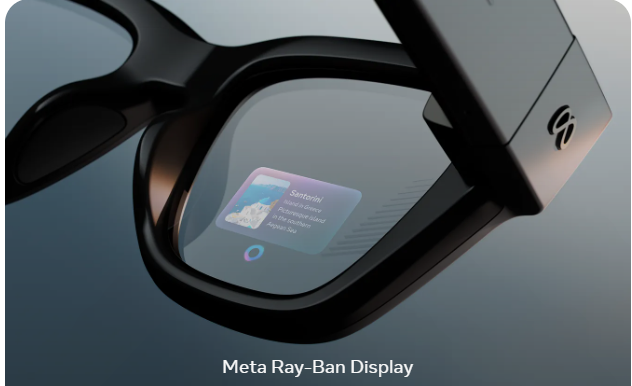
Meta’s smart glasses evolution took a stylish turn this fall with the Ray-Ban Meta Display (Gen 2), unveiled at Meta Connect on September 17, 2025. They are a sleek fusion of Ray-Ban’s iconic frames and Meta’s AI wizardry, packing a heads-up display, neural wristband controls, and hands-free smarts that make checking notifications feel like telepathy. Starting at $799 (bundled with the Neural Band), they’re available now at Best Buy (exclusive US retail), Ray-Ban.com, and select LensCrafters stores, with global shipping rolling out through December. But in a world of bulky VR behemoths like Apple’s Vision Pro and Samsung’s Galaxy XR, do these featherlight frames signal the end of pocket-sized screens? We break down the features, pricing, availability, and weigh if they’re a smartphone successor or just a killer accessory while stacking them against the XR giants.
Key Features: Subtle Smarts in a Stylish Package
The Ray-Ban Meta Display builds on the 2023 originals with a focus on discreet augmentation, turning everyday eyewear into an AI sidekick. At just 48g (lighter than the 50g Gen 1), they come in classic Wayfarer, Headliner, or Skyler frames with polarized/transitional lenses (prescription upgrades +$100). The magic? A monocular waveguide display etched into the right lens, projecting crisp, color notifications, captions, or previews without blocking your view.
Standout Upgrades
- AI-Powered Heads-Up Display (HUD): See live captions for calls/videos, picture previews before snapping, or turn-by-turn directions overlaid on reality. Meta AI (powered by Llama 3.2) handles queries like “What’s that landmark?” via voice, now with low-power on-device processing for privacy and speed.
- Camera and Audio Boost: 12MP ultra-wide sensor (up from 5MP) captures 1080p video at 60fps with improved stabilization; dual open-ear speakers (now with beamforming mics) deliver spatial audio for calls, podcasts, or AR-guided workouts. Hear your surroundings while staying connected.
- Neural Band Integration: The bundled wristband uses EMG (electromyography) sensors to detect subtle gestures like pinching for screenshots or swiping to scroll, making controls intuitive without touching your phone.
- Battery and Endurance: Up to 5 hours of mixed use (42% more than Gen 1), with a charging case adding 8 full charges (32 hours total). Low-power AI extends standby to 36 hours.
- Connectivity and Extras: Bluetooth 5.3, Wi-Fi 6E, IPX4 water resistance. Syncs with Meta View app for photo editing, live streaming to Instagram/Facebook, and AR filters. Health perks? Subtle step counting and posture reminders via AI.
It’s not full AR (no virtual objects floating in space), but the HUD’s subtlety shines for urban navigation or quick glances. Think Google Glass, but fashionable and less dystopian.
Price and Availability: Accessible Augmentation
Priced at $799 for the full kit (glasses + Neural Band in Matte Black or Shiny Tortoise), it’s a premium tag but far from XR headset territory. Standalone glasses run $399 (up from Gen 1’s $299), with the Band at $400 separately. Prescription lenses add $150 to $300; colors/styles vary $50 to $100.
Availability:
- US/Canada: Immediate at Best Buy (exclusive), Ray-Ban.com, LensCrafters (in-store fittings).
- Europe/Asia: Rolling out November 15 via Amazon and carriers like Vodafone.
- Global Shipping: Free via Meta.com; expect stock shortages through holidays.
Preorder bundles include 3 months of Meta AI Premium (ad-free, advanced features) and exclusive AR content like spatial concerts.
Will It Replace Smartphones?
Short answer: No, not yet, but it’s the closest we’ve come to making phones obsolete for daily drudgery.
These glasses excel at micro-interactions: Whisper “Hey Meta, text Mom ‘On my way'” during a walk, see a notification pop up without fumbling your pocket, or get real-time translations overlaid on foreign signs. Battery life and form factor make them a true “always-on” companion, chipping away at the 150+ times we check our phones daily. Meta’s vision, tied to Llama AI and Instagram, positions them as a social AR gateway, where sharing moments happens seamlessly (e.g., live-streaming your hike with AI-edited highlights).
But replacement? Smartphones remain kings for creation and immersion: Typing essays, editing 4K videos, or doom-scrolling aren’t HUD-friendly yet. Display real estate is tiny (monocular, ~1-inch equivalent), and privacy concerns (cameras everywhere) could stall adoption. In 5 to 10 years? With waveguide tech scaling (rumored binocular displays by 2027), they could evolve into “phone visors,” reducing slab dependency by 70% for notifications and basics. For now, they’re a killer complement. Pair with your iPhone 17 for the ultimate hands-free setup. Score: 8/10 for disruption potential.
Head-to-Head: Ray-Ban Meta Display vs. Apple Vision Pro vs. Samsung Galaxy XR
Meta’s glasses shine in wearability, but Apple’s Vision Pro and Samsung’s Galaxy XR (launched October 2025) are immersive powerhouses for productivity and entertainment. The Ray-Ban prioritizes subtlety and all-day use over deep dives. Its tiny size and gesture UI make it “better” for casual augmentation, but VR headsets win for virtual worlds.
- Size & Comfort: Ray-Ban’s 48g featherweight crushes the Vision Pro’s 650g ski-goggle bulk and Galaxy XR’s 545g (plus tethered battery). You forget you’re wearing them vs. “headache after 2 hours.”
- UI & Interaction: Neural Band gestures feel magical and phone-free; Vision Pro’s eye/hand tracking is precise but fatiguing; Galaxy XR’s controllers add gaming tactile feedback but clutter the experience.
- Display & Immersion: Glasses’ HUD is glanceable but limited (monocular, low-res); Vision Pro’s dual 4K micro-OLED (100° FoV) and Galaxy XR’s 3.5K (109° FoV) deliver cinema-level VR/AR. Ideal for spatial computing, not street strolls.
- Battery & Portability: 5+32 hours on glasses vs. 2 hours on headsets. Ray-Ban wins for mobility.
- Price & Value: $799 vs. $3,499 (Vision Pro) or $1,799 (Galaxy XR). Glasses democratize AI without the “wear a backpack” vibe.
| Feature | Meta Ray-Ban Display | Apple Vision Pro | Samsung Galaxy XR |
|---|---|---|---|
| Price (Base) | $799 (w/ Neural Band) | $3,499 | $1,799 |
| Weight | 48g | 600 to 650g | 545g + 302g battery |
| Display | Monocular waveguide HUD (color, ~1″ equiv.) | Dual micro-OLED (4K+/eye, 100Hz, 100° FoV) | Dual micro-OLED (3.5K/eye, 90Hz, 109° FoV) |
| Battery Life | 5 hrs (32 hrs w/ case) | ~2 hrs | 2 to 2.5 hrs (swappable) |
| UI/Controls | Voice + Neural Band gestures | Eye/hand/voice | Hand/eye/voice + controllers |
| Key Perks | All-day wear, social AR | Pro spatial computing, Apple ecosystem | Android app compatibility, Gemini AI |
| Best For | Everyday augmentation | Immersive work/entertainment | Balanced XR gaming/productivity |
Better Option? For size and UI, yes. Ray-Ban is the “always-with-you” choice, ditching headset isolation for seamless reality blending. But for deep XR (virtual meetings, 3D editing), Vision Pro/Galaxy XR dominate. If you’re headset-shy, Meta’s glasses are the gateway drug to AR life.
Verdict: The Shades That Steal the Show
At $799, the Ray-Ban Meta Display isn’t a smartphone killer yet, but it’s the most practical AR wearable of 2025, blending Ray-Ban’s cool with Meta’s brains for effortless augmentation. Availability is strong now, but stock up before holiday rushes. Against VR titans, its petite profile and intuitive UI make it “better” for daily life, not deep dives. Future-proof your feed: These could be the bridge to a screenless world. Tempted to ditch the slab? Grab a pair and see the (augmented) light. What’s your XR entry point, glasses or goggles? Sound off below!
More wearables? Check our Galaxy XR vs. Vision Pro face-off.