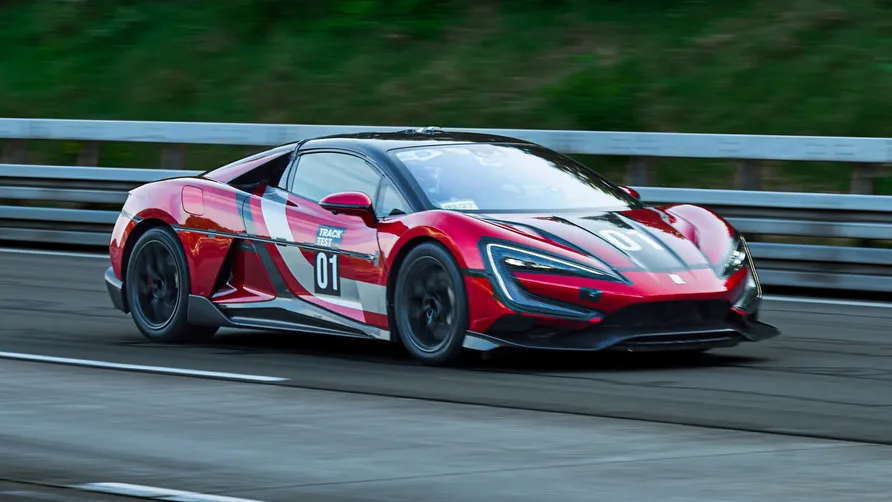
In a groundbreaking achievement for the electric vehicle (EV) industry, the Chinese hypercar Yangwang U9 has officially claimed the title of the world’s fastest production EV. On August 8, 2025, at the ATP Automotive Testing Papenburg track in Germany, a Yangwang U9 Track Edition prototype reached an astonishing top speed of 293.54 mph (472.41 km/h), surpassing all previous benchmarks and rewriting the rules of high-performance electric mobility. This feat not only highlights China’s growing dominance in the EV sector but also pushes the boundaries of what battery-powered vehicles can achieve.
Background on Yangwang and BYD
Yangwang is a relatively new entrant in the luxury EV market, launched in January 2023 as a premium sub-brand of BYD Auto. Headquartered in Shenzhen, China, Yangwang focuses on ultra-high-end vehicles priced in the million-yuan range (around $140,000 and up), targeting affluent buyers seeking cutting-edge technology, superior performance, and opulent design. The brand’s name, which translates to “look up” in Chinese, symbolizes aspiration and innovation, drawing on BYD’s vast resources to deliver vehicles that blend luxury with extreme capability.
BYD itself has a storied history that underpins Yangwang’s rapid success. Founded in 1995 as a rechargeable battery manufacturer, BYD (Build Your Dreams) quickly became a global leader in energy storage solutions. The company expanded into automobiles in 2003, leveraging its battery expertise to pioneer affordable and efficient EVs. Today, BYD is one of the world’s largest EV producers, outselling competitors like Tesla in certain markets. With a diverse portfolio spanning passenger cars, commercial vehicles, rail transit, and renewable energy, BYD employs over 700,000 people and operates in more than 70 countries. Its vertical integration—from battery production to vehicle assembly—gives subsidiaries like Yangwang a competitive edge in innovation and cost efficiency. Yangwang’s debut models, including the U8 luxury SUV and the U9 supercar, showcase BYD’s advanced e4 platform, which enables features like tank turns, emergency floating in water, and blistering acceleration.
The Yangwang U9: A Technological Marvel
The U9 is Yangwang’s flagship all-electric supercar, unveiled in February 2024 with a starting price of about 1.68 million RMB (roughly $230,000). Powered by four independent electric motors delivering a combined 2,959 horsepower and 1,243 lb-ft of torque, the U9 accelerates from 0 to 60 mph in under 2 seconds. Its sleek, aerodynamic design, inspired by futuristic aesthetics, incorporates active aerodynamics, carbon fiber construction, and a 120-kWh blade battery for extended range and rapid charging. The Track Edition, used in the record attempt, features enhancements like optimized tires, reduced weight, and fine-tuned software to maximize top-end performance. Beyond speed, the U9 offers practical supercar traits, including a luxurious interior with advanced driver aids and connectivity.
Comparison with the Rimac Nevera
The previous EV top speed record was held by the Croatian hypercar Rimac Nevera, which achieved 256 mph (412 km/h) in 2022. An updated variant, the Nevera R, pushed this to 268.2 mph (431.45 km/h) in July 2025, showcasing Rimac’s prowess in electric hypercar engineering. However, the Yangwang U9’s 293.54 mph eclipses both, marking a 25 mph leap over the Nevera R and demonstrating superior power delivery and stability at extreme velocities.
Both vehicles are quad-motor EVs with massive power outputs—the Nevera boasts 1,914 hp, while the U9’s 2,959 hp gives it a clear edge in raw thrust. The Nevera, priced at around $2.4 million, emphasizes track versatility with records in acceleration (0-60 mph in 1.74 seconds) and handling, including a Nürburgring lap time of 7:05.298. In contrast, the more affordable U9 prioritizes straight-line speed and innovative features like its ability to “dance” on three wheels or perform jumps. Aerodynamically, the U9’s design yields a lower drag coefficient, aiding its record-breaking run on the same Papenburg track where the Nevera was tested. Battery-wise, both use advanced lithium-ion packs, but BYD’s in-house tech provides the U9 with potentially better thermal management for sustained high-speed runs.
While the Nevera represents European engineering excellence from a boutique manufacturer (Rimac, now part of Bugatti-Rimac), the U9 embodies mass-market scalability backed by BYD’s manufacturing might. This contrast underscores a shift in the EV landscape, where Chinese brands are challenging established players.
Looking Ahead
The Yangwang U9’s record isn’t just a number—it’s a statement of intent from BYD’s luxury arm, signaling that EVs can rival or exceed internal combustion supercars in every metric. As Yangwang eyes global expansion, including potential launches in Europe, the U9 could redefine hypercar ownership. With climate concerns driving EV adoption, achievements like this accelerate the transition to sustainable speed. Whether on the track or the street, the U9 proves that the future of performance is electric—and faster than ever.